
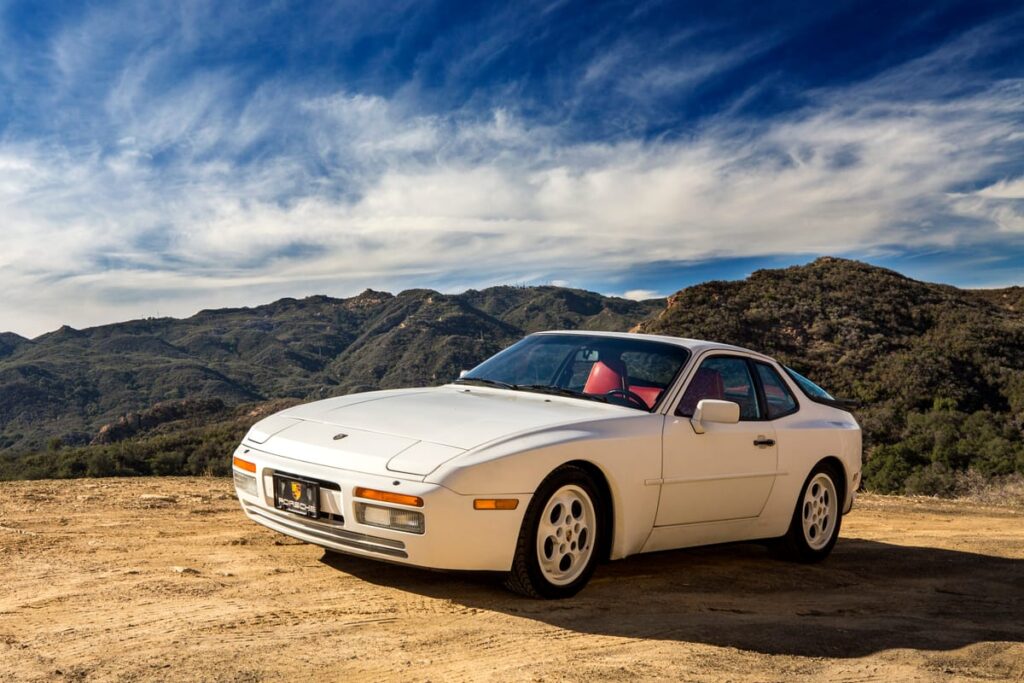
The Porsche 924 remains one of the most misunderstood cars in Porsche history. Almost fifty years after its introduction, it continues to be evaluated not for what it represents, but for what it was never meant to be.
The issue with the 924 does not concern only its Audi-sourced engine or the fact that it has a front-engine layout. It concerns the way it continues to be compared to the 911. This is precisely where its undervaluation begins.
The 924 is often interpreted as an incomplete Porsche, a budget solution or a deviation from the brand’s tradition. In reality, it was born from a different logic.
Contenuti
The project was never meant to be a 911
The 924 was never designed to replicate the 911 in a more accessible form. Porsche was working on a different idea of a sports car: more rational, more balanced and more usable on a daily basis, with a more progressive and readable dynamic behavior in real driving conditions.
The transaxle layout, with the gearbox mounted at the rear and a more balanced weight distribution, followed a precise technical logic. In this context, the front-engine configuration was not a random compromise, but an integral part of the project.
The problem is that the 924 was interpreted through expectations that belonged to the 911. For many enthusiasts, a Porsche with a front-engine layout and mechanical components shared with the Volkswagen-Audi world appeared incompatible with the historical identity of the brand. This perception ended up obscuring the actual quality of the project.
The Audi engine: the real issue was perception
The Audi-derived engine is still one of the main elements used to diminish the 924, often to the point of overshadowing the technical analysis of the project as a whole.
In reality, the issue was not so much the origin of the engine, but the symbolic meaning associated with that choice. For part of the Porsche audience, the very idea of shared components was perceived as a loss of technical purity. This contributed to creating a prejudice that lasted for decades.
Yet reducing the 924 to the origin of its engine means ignoring the engineering work Porsche developed around that architecture. Suspension setup, weight distribution, dynamic behavior and the car’s overall philosophy all responded to a precise vision.
The controversy, therefore, did not concern technology alone, but the way part of the public interpreted the very concept of Porsche.
Driving tells a different story
The undervaluation of the 924 becomes most evident when the car is judged through its technical specifications rather than through the driving experience. The 924 does not impress through brutality or outright performance. Its real strength is balance.
The transaxle layout allows for a more neutral weight distribution than the contemporary 911, while the dynamic behavior is progressive, readable and less demanding at the limit. This does not make it less of a Porsche, only a different kind of Porsche.
The 924 requires a less ideological and more technical approach. It must be understood through the way it transfers weight, settles into corners and builds speed. For this reason, many contemporary re-evaluations of the 924 come from real driving experiences rather than from its historical image.
Turbo, Carrera GT and 924S: the project beyond prejudice
The later evolutions of the 924 demonstrate how much potential the project actually had. The 924 Turbo introduced a completely different level of performance while maintaining the balance of the original chassis. The Carrera GT pushed the project toward a far more specialized direction, while the 924S represented a further technical refinement.
These models did not change the meaning of the 924, but made it clear that the car’s main limitation was never the project itself, but the way it had been perceived and interpreted over time.
Why it is still underrated today
Even today, the 924 continues to occupy an ambiguous position within the Porsche world. For some enthusiasts, it remains a “lesser” Porsche; for others, it is simply a less desirable transaxle compared to the 944. At the same time, however, the context has changed.
The increasing standardization of contemporary sports cars has made the value of lightweight, readable cars built around a clear mechanical logic far more evident.
This is precisely where the 924 becomes more interesting than it once was. Not because it has suddenly become rare or expensive, but because it is now easier to understand the logic behind the project.
The Porsche 924 remains underrated because it is still interpreted through categories that do not belong to the project from which it was born. It is neither a failed 911 nor an incomplete Porsche.
It is a Porsche that attempted to redefine the very meaning of the brand’s sports car, anticipating a technical and industrial logic that would influence much of Porsche’s later production. The problem with the 924 was never what it was, but the way it was judged.

