
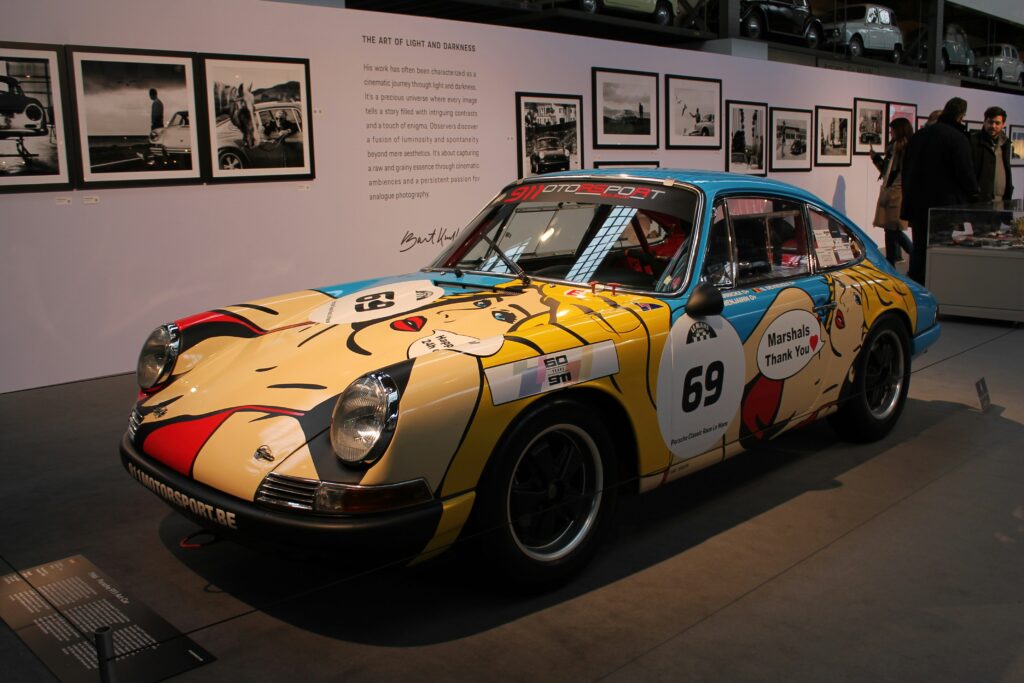
Since the 1960s, the relationship between Porsche and art has never been a mere marketing exercise or a decorative concession. Instead, it represents a structured dialogue between two worlds that share fundamental values: form, function, a pursuit of the essential, and beauty achieved through engineering. When Porsche meets art, the automobile ceases to be only an industrial object and becomes an expressive medium, a conceptual surface, and at times a true work of art.
These intersections show how Porsche has used art to question and refine its own design language, transforming cars and cultural initiatives into tools for reflection on design, identity, and historical value-far beyond the idea of a special livery or a stylistic exercise.
Contenuti
Cultural foundations: Porsche design as a visual language
Long before engaging directly with artists, Porsche developed a distinctive and coherent design grammar, rooted in enduring principles such as functional clarity, structural lightness, and continuity of surfaces. Over time, these elements made a Porsche instantly recognizable even outside the automotive context.
From the 356 to the 911, evolution rather than disruption became a cultural manifesto. This approach naturally attracted the interest of the art world, where Porsche is often cited as a virtuous example of industrial design capable of spanning decades without losing coherence.
It is no coincidence that numerous design museums have included Porsche models in their permanent collections, acknowledging the automobile as an object that transcends pure functionality and fully enters the realm of cultural discourse.
Porsche and Art Cars: when the surface becomes narrative
One of the most evident territories where Porsche and art intersect is that of Art Cars, where iconic models such as the 911 have served as the basis for artistic interventions capable of engaging with the original design rather than negating it. In these projects, the automobile becomes a medium for reflection on speed, form, and identity.
Although the Art Car concept is historically associated with other manufacturers, Porsche has also allowed space for artistic interpretations aligned with its own identity. In these cases, the car is not simply “decorated” but reinterpreted: the original design remains legible, yet is placed in tension with the artist’s language, creating a delicate balance between respect and experimentation.
The Porsche Museum as a cultural platform
If Art Cars represent collaborations acting directly on the automobile itself, the Porsche Museum marks a shift toward artistic projects developed around the car. No longer limited to the bodywork, these initiatives unfold within the broader cultural context surrounding the automobile.
In this sense, the Porsche Museum is not merely an exhibition space dedicated to brand history, but a true cultural hub. Over the years, it has hosted temporary exhibitions, installations, and collaborations with artists and designers, demonstrating how the automobile can engage in dialogue with sculpture, photography, and conceptual art.
These initiatives are never self-referential: the car often becomes the starting point for broader reflections on themes such as the relationship between humans and machines, the aesthetics of performance, and the role of technology in contemporary society.
Fashion, photography, and popular culture: Porsche as a visual icon
Another key area of interaction between Porsche and art lies in photography and fashion. Here, the automobile becomes a narrative and symbolic element, capable of conveying lifestyle, desire, and aspiration.
In this context, the boundary between art and popular culture becomes increasingly fluid, yet Porsche’s visual coherence remains central. The brand thus moves beyond its mechanical identity, establishing itself as a cultural icon in continuity with other dimensions already explored, such as cinema and celebrity culture.
Collecting and value: when art shapes history
From a collector’s perspective, Porsche’s artistic collaborations hold a particular kind of value. Not so much for aesthetic uniqueness alone, but for their ability to document an era, a visual language, and a specific cultural mindset.
A car involved in a meaningful artistic project becomes a cultural witness, influencing how it is perceived historically. For the informed collector, these initiatives represent a natural extension of interest in Porsche-not only in terms of mechanics and performance, but also context, meaning, and memory.
Porsche as a total cultural object
When Porsche meets art, one fundamental truth becomes clear: the Stuttgart-based brand is not only an automobile manufacturer, but also a producer of visual and technical culture. Looking ahead, this role will increasingly involve engaging with artistic languages capable of interpreting mobility, technology, and identity in a contemporary key.
The most successful artistic collaborations are those that respect this identity without distorting it. For enthusiasts, understanding them means reading Porsche on a deeper level—where design, history, and art merge into a coherent and enduring narrative.

