
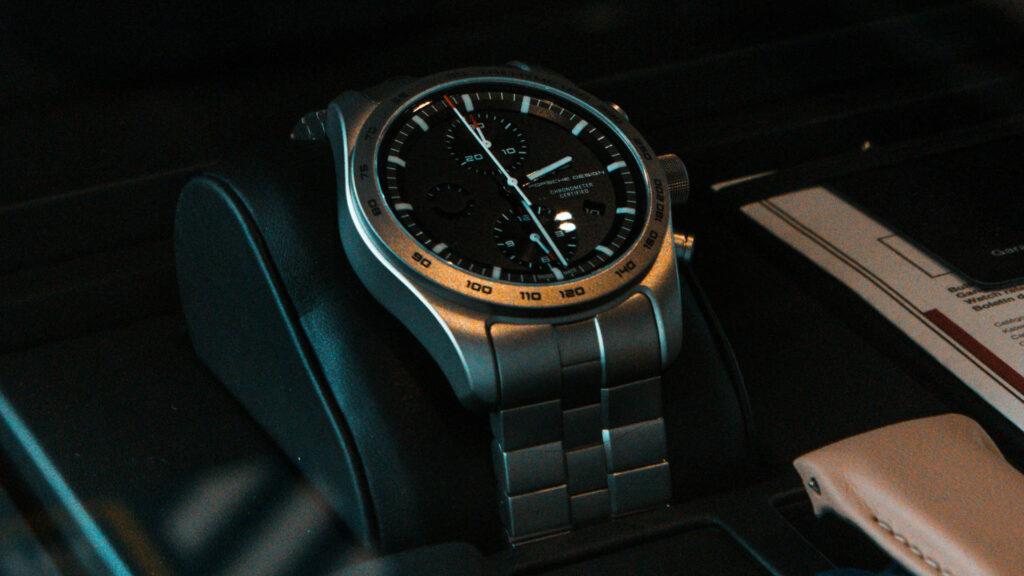
In the Porsche world, time has never been an abstract concept, but a measurable, readable and controllable technical variable, as demonstrated both by onboard instrumentation and by wearable tools developed according to the same design logic. It is measurement, precision and repeatability. It is the constant reference that governs engine operation, chassis response and race strategy. In this context, Porsche watches were not conceived as simple accessories, but as a coherent extension of the brand’s technical philosophy: functional instruments designed according to the same principles of clarity, legibility and engineering rigor applied to Porsche automobiles.
Here, the focus shifts to Porsche watches as technical and cultural objects, created to meet requirements of function, precision and legibility. For a broader perspective on the topic, readers can refer to the in-depth feature on Porsche Lifestyle, which provides context for the brand’s approach to design, clothing and accessories. These are not decorative items, but instruments that in certain cases have played a meaningful role in Porsche history precisely because they were designed according to the same criteria applied to its cars.
Contenuti
Porsche design: when function shapes form
The origins of Porsche watches are inseparably linked to Porsche Design, founded by Ferdinand Alexander Porsche in the early 1970s. The guiding principle was the same that had led to the definition of the 911: eliminate the superfluous and allow function to dictate form. This was not about transferring automotive styling onto a wristwatch, but about applying a rigorous, cross-disciplinary and coherent design methodology.
The first concrete result of this approach was the now-iconic Chronograph I of 1972. The choice of an entirely black case, inspired by cockpit instruments and anti-reflective treatments used in aviation, broke sharply with the traditional watchmaking aesthetics of the period. Here, decoration was secondary to maximum legibility in all operating conditions, a theme that would become central throughout subsequent production.
Watches as instruments, not symbols
This instrumental approach becomes particularly evident in the professional use of Porsche watches within motorsport and technical environments. Drivers, engineers and team members adopted these chronographs as genuine operational tools, useful for measuring lap times, stints and race references, in direct continuity with the instrumentation found inside the cockpit. The watch thus becomes part of a functional ecosystem rather than a purely aesthetic accessory.
One of the aspects that distinguishes Porsche watches from many contemporary productions is precisely this instrumental nature. The chronograph is not an aesthetic pretext, but a central function, as are dial clarity, color contrast and push-button ergonomics. In this sense, the connection to motorsport is not narrative or celebratory, but deeply functional.
During the 1970s and 1980s, several Porsche Design models were used in sporting and professional contexts, often in collaboration with Swiss manufacturers such as Orfina or IWC. PVD-coated steel cases, tachymeter scales readable at a glance and the absence of unnecessary decorative elements follow the same logic that governs the instrumentation of a competition car.
Materials and technical solutions: coherence before innovation
As with Porsche automobiles, the adoption of new materials in Porsche watches has never been an end in itself. Titanium, for example, was introduced not to impress, but to reduce weight and improve comfort during prolonged wear, while maintaining high structural strength. It is a choice fully consistent with the approach applied to the brand’s most extreme vehicles.
The same philosophy applies to the evolution of cases and bracelets, designed to be functional before becoming iconic. Matte finishes, anti-reflective surfaces and the absence of superfluous polishing respond to real-world use requirements rather than display purposes. Even in more recent models, the connection to the Porsche world remains technical and project-driven, not nostalgic.
Movements, reliability and maintenance
Throughout its history, Porsche Design has adopted different movements depending on technical context and era. Early chronographs used Swiss-made automatic mechanical movements, selected for their robustness and their ability to deliver time measurement consistent with sporting and professional use.
The introduction of quartz, particularly between the late 1970s and the 1980s, should not be interpreted as a technical downgrade, but rather as a functional response to demands for precision, reliability and reduced maintenance, in line with Porsche’s engineering mindset of that period. In this case as well, movement selection was driven by real-world use rather than purely collectible considerations.
For collectors and enthusiasts who actively wear their watches, this aspect is crucial. Vintage models today require knowledgeable maintenance, particularly with regard to PVD-coated cases and components subject to wear. As with a classic Porsche, originality and adherence to original specifications directly affect both reliability and long-term value.
Conscious collectibility and real-world use
Discussing Porsche watches also means distinguishing between coherently designed objects and simple merchandising products. Historic Porsche Design models, as well as certain later productions resulting from solid technical collaborations, have acquired collectible value precisely because they represent an authentic extension of Porsche thinking.
This does not imply that they should be confined to a safe. On the contrary, many of these watches were conceived for daily use, exactly like the brand’s automobiles. In this case, collectibility is not in opposition to use, but rather a direct consequence of a valid and coherent project.
Porsche watches and the brand’s technical culture
In a landscape where the boundary between design, luxury and lifestyle is often blurred, Porsche watches represent a distinctive case. They are neither status symbols nor exercises in style for their own sake, but objects that reflect a precise technical culture built around function, legibility, appropriate materials and coherent solutions.
For Porsche enthusiasts, understanding these watches means grasping an additional element of the brand’s identity: not a commercial extension, but a shared language spanning automobiles, industrial design and measuring instruments. It is within this deep coherence that their true value resides, today as in the past.

